
If you own a home in Birmingham and you have ever typed your address into Zillow, Redfin, or another real estate website, you know the feeling. A number pops up — sometimes surprisingly high, sometimes frustratingly low — and you are left wondering whether that figure means anything when it comes time to actually sell.
The short answer is: it means something, but far less than most homeowners assume.
The difference between what a website estimates, what a buyer is willing to pay, and what actually ends up in your pocket can be significant. That gap affects how you price, how long you wait, which offers you consider, and which selling path actually makes sense for your situation.
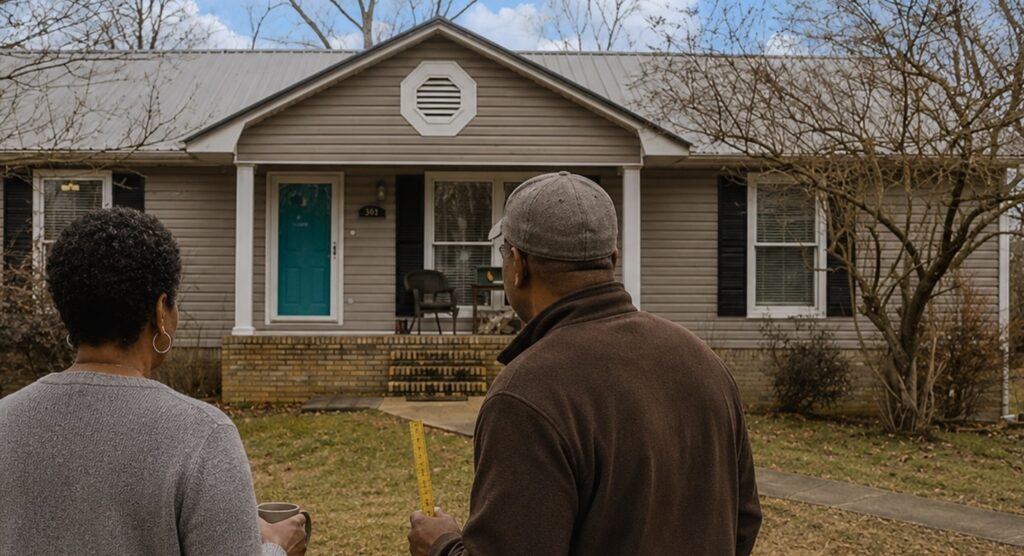
At Levi Home Buyers, we work with homeowners across Birmingham and Alabama, including Roebuck, Hoover, North Birmingham, Hueytown, Center Point, and throughout the metro. One pattern shows up again and again: sellers who understand the difference between estimated market value and selling reality make clearer decisions.
Why Homeowners and Buyers Often See Value Differently
Homeowners and buyers are not always looking at the same property, even when they are standing in the same room.
Homeowners see history: the years of mortgage payments, the weekend projects, the landscaping, the repairs, the updates, and the memories attached to the home. That history matters. But to a buyer walking through for the first time, it does not carry the same weight.
Buyers are asking a different question: does this home fit my future, in a condition I can live with, at a price that makes sense right now?
Buyers are not paying for the history you built in a home. They are paying for the future they imagine living in it.
In Birmingham, that gap can be even sharper because neighborhoods can shift quickly. A home in Hoover may carry different buyer expectations than one in Roebuck, Ensley, or West End. Even homes only a few streets apart can attract different buyer pools, different financing realities, and different price expectations.
That is why value on paper and buyer response in the real market are not always the same thing.
Why Online Estimates Rarely Tell the Full Story
Automated valuation models — the systems behind estimates on Zillow, Redfin, and similar platforms — are useful tools. They analyze recent sales, tax records, square footage, year built, and neighborhood trends. For a broad market picture, they can help.
But when it comes to your specific home, on your specific street, in its current condition, their limits matter.
These tools cannot walk through your property. They do not know whether your HVAC system was recently replaced or nearing the end of its life. They cannot tell if the roof still has years left, whether major systems have been updated, or whether buyers will immediately notice deferred maintenance.
An algorithm can see your address and square footage. It cannot see your electrical panel, your crawl space, or what is sitting behind the walls.
That matters in Birmingham, where many homes are older and condition can vary widely from one property to the next. Two houses on the same street with similar square footage can sell for very different numbers based on maintenance, updates, systems, and overall condition.
Online estimates can be helpful as a starting point. Just be careful not to treat them as a pricing strategy or a negotiation tool.
What Buyers Quietly Calculate Before Making an Offer
Most buyers are running a calculation before they ever make an offer. They may not say it out loud, but the math is happening.
The first thing many buyers think about is monthly cost, not just purchase price. Even a modest price difference can affect affordability, especially when interest rates are high or buyers are already near the edge of loan approval.
Buyers also factor in visible repairs and uncertainty. If they see an older roof, outdated electrical, aging HVAC, or a kitchen and bathrooms that need work, they do not only estimate repair costs. They add a risk buffer.
Buyers do not just price in the cost of repairs. They price in the cost of not knowing what they have not discovered yet.
They also compare your home to everything else currently available. If similar homes nearby are updated and move-in ready, buyers may not negotiate hard with you. They may simply move on.
And if the buyer is using financing, the appraisal matters. A lender will not fund a loan above appraised value. So even if a buyer likes your home, the deal still has to survive lender review, comparable sales, and appraisal risk.

The Difference Between Gross Price and Net Outcome
This is one of the most important distinctions in selling a house.
The gross sale price is the headline number. It is the number people compare to nearby sales. It is the number that sounds impressive.
The net outcome is what actually lands in your bank account after the costs of selling are taken out.
The gross price is what people talk about. The net outcome is what you actually live on.
A traditional home sale in Birmingham may include agent commissions, seller-paid closing costs, inspection-related repairs, credits to the buyer, and holding costs while the home sits on the market. Mortgage payments, taxes, insurance, utilities, and maintenance do not stop just because the house is listed.
A home that sells for $220,000 may not leave the seller with anything close to $220,000 once the full process is finished.
This is why a direct cash offer should not be compared only against the list price. It should be compared against the likely net result. When you account for no agent commissions, no required repairs, no seller-paid closing costs, and no long waiting period, the gap between a traditional sale and a direct sale can look very different.
For homeowners comparing different selling options, understanding how to sell your house as-is in Birmingham can provide a useful point of comparison.
Why Some Homes Struggle Even When the Estimated Value Looks High
One of the most frustrating situations for sellers is when an online estimate looks strong, but the market does not respond.
The home gets listed. Showings are slow. Offers do not come in. Weeks pass. Then the seller starts wondering what went wrong.
Often, the issue is condition mismatch. Online estimates are driven mostly by data: location, size, and past sales. Buyers are comparing what they see right now. If your home needs $25,000 to $40,000 in work while other homes at the same price are updated, buyers will adjust quickly.
Another issue is Birmingham’s micro-market reality. The city does not move as one market. Some neighborhoods have strong buyer demand. Others are slower. Sometimes two streets can feel like two different markets.
In Birmingham, two streets can represent two entirely different markets. That is something an algorithm will never fully capture.
Then there is the stale listing effect. When a home sits for 30 or 45 days without going under contract, buyers start asking questions. Is something wrong? Is it overpriced? Did other buyers already see a problem?
Sometimes the most expensive mistake is not pricing too low. It is starting too high, losing momentum, and chasing the market down later.
When Simplicity Starts Becoming Part of the Value
For some sellers, the traditional process is not just inconvenient. It is not realistic.
Think about a homeowner who inherited a property that has been vacant for years. The home may need major work. Getting it ready for traditional buyers could require time, money, cleaning, repairs, and coordination the seller does not have.
For someone in that situation, the theoretical value of a fully updated home may not matter much. What matters is what can realistically happen now.
That is often true for sellers going through divorce, relocation, financial pressure, difficult tenants, or other major life transitions. In those situations, certainty can be worth a lot.
The same is often true for landlords who own a rental property that has become more work than they expected. Deferred maintenance, vacancies, tenant issues, and ongoing expenses can gradually change the equation over time. For owners in that situation, exploring their options for selling a rental property in Birmingham may provide a clearer picture of what makes sense financially.
Speed and certainty are not consolation prizes. For the right seller, they are exactly what the transaction should be built around. And for families dealing with an inherited property, taking the time to understand their options for an inherited house in Birmingham can often make the next step much clearer.
A Better Question Than “What Is My House Worth?”
The question most homeowners start with is natural:
What is my house worth?
But that question is only a starting point. A better question is:
What outcome do I actually need from this sale, and which path gets me there most reliably?
Some sellers need the highest possible net proceeds. They have time, the house is in strong condition, and they are comfortable preparing, listing, showing, negotiating, and waiting.
For those sellers, the traditional listing route may make sense.
Other sellers need certainty and speed. They cannot wait months. They cannot handle repair negotiations. They do not want the risk of a financed deal falling apart right before closing.
For them, a direct cash sale may be a rational choice, even if the gross offer looks different from a traditional retail sale.
Still others are dealing with homes where the open market is not realistic without major work: structural problems, title issues, difficult tenants, probate, or years of deferred maintenance.
In those cases, the best question is not what the home might be worth in perfect condition. It is what path actually works based on the home’s real condition and the seller’s real constraints.
To understand the direct-sale path better, how the process works can help clarify what to expect.
Conclusion
Market value in Birmingham is not a fixed number on a screen. It is shaped by buyer psychology, neighborhood demand, property condition, active inventory, financing limits, and the cost of time.
The goal is not to say that listing with an agent is wrong. It often works well. The goal is to replace vague optimism with practical thinking, because that is what leads to better decisions.
Whether you are considering listing, exploring a direct cash sale, dealing with a complicated property, or simply trying to understand your options, the foundation is the same: honest information about your specific house and your specific situation.
At Levi Home Buyers that is what we try to offer: a real conversation, a fair and transparent offer, and no pressure. If you’d like additional perspective before making a decision, you can see what local sellers say about working with us.
Give us a call or send a message whenever you are ready. There is no obligation — just a straightforward look at your options.